10 Local SEO Ranking Factors Businesses Should Know
Improve Local Search Visibility, Google Maps Rankings, and Customer Reach
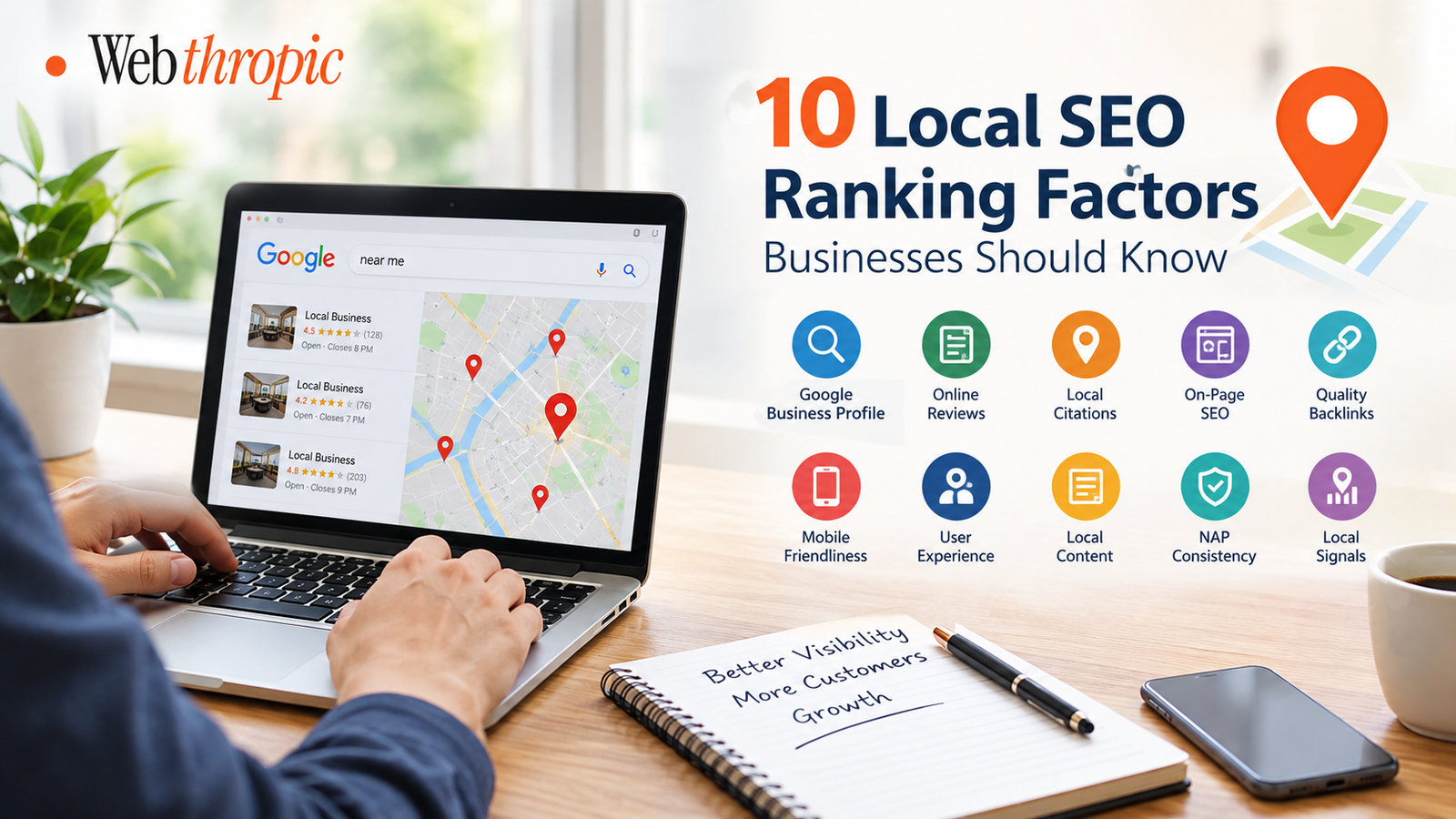
10 Local SEO Ranking Factors Businesses Should Know
In today's competitive digital landscape, appearing in local search results is essential for businesses that want to attract nearby customers. Whether you run a retail store, healthcare clinic, restaurant, consultancy, or service-based company, your potential customers often search online before making a purchase or booking a service.
This is where Local SEO Ranking Factors become important. Local SEO helps businesses improve their visibility in Google Search and Google Maps when people search for relevant products or services in a specific area. For example, searches such as “website development company in Patna,” “best dentist near me,” and “digital marketing agency in Delhi” demonstrate how customers use location-based searches to find businesses.
Google explains that local results are primarily influenced by three factors: relevance, distance, and prominence. Understanding these principles can help businesses build a more effective local search strategy.
In this guide, we explore 10 important local SEO ranking factors and practical ways to use them to improve local visibility, attract qualified traffic, and generate more business opportunities.
1. Google Business Profile Optimization
A well-optimized Google Business Profile is one of the most important foundations of local SEO. It helps customers discover your business through Google Search and Maps and provides essential information about your services.
Start by claiming and verifying your profile. Ensure that your business name, address, phone number, website, opening hours, and service information are accurate.
Choose the most relevant primary business category and add appropriate secondary categories. Upload genuine photographs of your workplace, products, team, or completed projects where relevant.
2. Local Keyword Research
Keyword research helps you understand the phrases potential customers use when searching for businesses like yours. Effective local SEO requires identifying keywords that combine your services with relevant cities, neighbourhoods, or locations.
For example, a web development company might target:
- Website development company in India
- Local SEO services in Patna
- Digital marketing agency in Delhi
- Ecommerce website development company
- SEO services near me
Include relevant local keywords naturally in page titles, meta descriptions, headings, service pages, and website content. Avoid repeating the same keyword excessively, as keyword stuffing can harm readability and create a poor user experience.
Actionable tip: Create dedicated location pages when your business genuinely serves multiple areas. Each page should provide useful, location-specific information rather than simply replacing one city name with another.
3. Consistent Business Information Across the Web
Your business name, address, and phone number are commonly referred to as NAP information. Keeping these details accurate across your website, Google Business Profile, business directories, and social media profiles helps customers identify and contact your business confidently.
Inconsistent information can create confusion. For example, an outdated phone number on a directory may prevent potential customers from reaching you.
Build relevant business citations on reputable directories and industry-specific websites. For Indian businesses, suitable platforms may include Justdial, IndiaMART, and other legitimate directories relevant to your industry.
Actionable tip: Audit your existing listings, correct outdated information, and address duplicate profiles where possible. Prioritize trusted and relevant directories over submitting your business to every available website.
4. Customer Reviews and Ratings
Online reviews influence how potential customers perceive your business. Positive, genuine feedback can strengthen trust and help people decide whether to contact you.
Google also identifies review count and positive ratings as factors that can contribute to local ranking prominence. However, reviews alone cannot guarantee a top position.
Encourage customers to share honest feedback after a purchase or completed service. Respond professionally to positive and negative reviews, acknowledge concerns, and explain how you intend to address genuine problems.
Never purchase fake reviews or pressure customers into leaving only positive feedback.
Actionable tip: Make requesting reviews a regular part of your customer service process. A steady flow of authentic feedback can support your online reputation and help prospective customers make informed decisions.
5. On-Page Local SEO Optimization
Your website should clearly communicate what your business offers and which locations it serves. On-page local SEO helps search engines understand the relationship between your services, website pages, and target audience.
Optimize important elements, including:
- SEO-friendly page titles and meta descriptions
- Clear H1 and H2 headings
- Relevant local keywords
- Descriptive image alt text
- Internal links between related pages
- Accurate contact and location information
For example, a company offering local SEO services should have a dedicated service page explaining its approach, deliverables, benefits, and ideal customers.
Avoid creating thin pages with almost identical content for different locations. Instead, offer useful information that addresses each area's actual customer needs.
Actionable tip: Audit your main service pages and make sure each page has a clear purpose, useful content, and an appropriate call to action.
6. Website Mobile-Friendliness and Page Speed
Many people search for nearby businesses using smartphones. If your website loads slowly, displays incorrectly, or makes contact information difficult to find, visitors may leave before contacting you.
A mobile-friendly website should adapt to different screen sizes, use readable fonts, provide accessible navigation, and display clickable phone numbers where appropriate.
Page speed also matters for user experience. Compress oversized images, reduce unnecessary scripts, use efficient hosting, and enable browser caching where suitable.
You can evaluate website performance using Google PageSpeed Insights and review Core Web Vitals to identify potential usability and performance problems.
Actionable tip: Test your website on both mobile and desktop devices. Make sure visitors can quickly understand your services, find your location, and submit an enquiry without unnecessary steps.
7. Local Content Marketing
Publishing helpful, locally relevant content can attract people who are researching services in your target area. It also helps establish your business as a useful source of information.
Instead of publishing only general articles, create content that addresses local customer questions, common problems, service considerations, and industry developments.
For example, a digital marketing agency could publish articles such as:
- How Local SEO Helps Small Businesses Attract Nearby Customers
- Local SEO Checklist for Businesses in India
- How to Optimize a Google Business Profile
- Website Development Tips for Local Businesses
Include location-specific information only when it adds genuine value. Case studies, project examples, local customer questions, and practical guides can make your content more useful.
Actionable tip: Build a consistent content calendar around your customers' search intent. Link relevant blog articles to your service pages to help readers discover related solutions.
8. High-Quality Local Backlinks
Backlinks are links from other websites to your website. Relevant, trustworthy backlinks can support your website's authority and prominence in search results.
For local SEO, focus on earning links from legitimate sources connected to your business, industry, or community. Potential opportunities include local news publications, business associations, professional organizations, community initiatives, and relevant industry blogs.
You can also develop useful resources, publish original research, or participate in legitimate partnerships that naturally encourage other websites to reference your business.
Avoid buying large volumes of low-quality links or relying on automated link-building schemes. These tactics may create risks without delivering sustainable results.
Actionable tip: Prioritize the relevance and quality of backlinks rather than simply counting them. A useful link from a trusted local organization may be more valuable than numerous unrelated links.
9. Local Business Schema Markup
Structured data helps search engines interpret important information about your business. LocalBusiness schema is a type of structured data that can describe details such as your business name, address, telephone number, website, and opening hours, where applicable.
Implementing accurate schema markup can improve how search engines understand your business information. However, structured data does not guarantee higher rankings or special search-result displays.
Ensure that your markup reflects information visible on your website and follows Google's structured data guidelines. Avoid adding inaccurate addresses, misleading ratings, or details that do not apply to your business.
Actionable tip: Use Google's Rich Results Test where supported and validate your structured data. Ask a developer or SEO specialist to review the implementation if you are unsure how to add it correctly.
10. Local SEO Tracking and Performance Analysis
Local SEO is an ongoing process. Monitoring performance helps you understand which activities are working and where improvements are needed.
Track relevant metrics such as:
- Local keyword rankings
- Google Maps and local search visibility
- Website organic traffic
- Google Business Profile calls and website clicks
- Customer enquiries and form submissions
- Review growth and customer feedback
- Conversions from local landing pages
Google Search Console can help you understand website search performance, while Google Analytics can provide insights into website traffic and conversions. Google Business Profile performance data can offer additional information about customer interactions.
Remember that rankings may vary according to search location, competition, and the type of search being performed.
Actionable tip: Review your performance monthly, identify pages or locations that need improvement, and prioritize actions based on actual business goals rather than rankings alone.
Why Local SEO Matters for Business Growth
Local SEO helps businesses become more discoverable when potential customers are actively looking for relevant services. A strong strategy combines accurate business information, a useful website, customer trust, relevant content, and a consistent approach to performance improvement.
For small and medium-sized businesses, these efforts can support greater local visibility, more qualified enquiries, and stronger customer relationships. Results depend on competition, location, business relevance, website quality, and the consistency of optimization efforts.
Remember that no single technique guarantees first-page rankings. Sustainable growth comes from improving several areas together while providing genuine value to customers.
Conclusion
Understanding these 10 Local SEO Ranking Factors can help businesses build a stronger foundation for local search success. From optimizing your Google Business Profile and targeting local keywords to earning quality backlinks and monitoring performance, each activity contributes to a more effective local SEO strategy.
The key is to focus on accuracy, relevance, trust, and a positive user experience instead of chasing shortcuts.
If your business wants to improve its visibility in local search results, professional guidance can help you identify opportunities, address technical issues, and create a strategy aligned with your target locations.
Looking to improve your local search visibility? Explore Webthropic's Local SEO Services to learn how a structured local SEO strategy can support your business's online growth.
Frequently Asked Questions (FAQs)
1. What are Local SEO Ranking Factors?
Local SEO ranking factors are signals that help search engines determine which businesses appear for location-based searches. Google's main local ranking principles are relevance, distance, and prominence.
2. How can I improve my local SEO ranking?
Start by optimizing your Google Business Profile, maintaining accurate business information, collecting genuine customer reviews, improving your website, publishing helpful local content, and earning relevant backlinks.
3. Are Google reviews important for local SEO?
Yes. Google states that review count and positive ratings can help local ranking prominence. Reviews also help potential customers assess a business's reputation.
4. How long does local SEO take to show results?
There is no fixed timeline. Results depend on competition, your current online presence, the quality of your website, and the improvements you implement. Regular monitoring helps you measure progress.
5. Can small businesses benefit from local SEO?
Yes. Local SEO can help small businesses reach customers searching for nearby products and services, improve online discoverability, and generate relevant enquiries.
6. Is Google Business Profile enough for local SEO?
No. It is an important part of local SEO, but a comprehensive strategy should also address website optimization, customer reviews, local content, business citations, backlinks, and performance tracking.

