Strategic Content Development: A Practical Guide to Building Content That Drives Real Results
A step-by-step framework for planning, creating, distributing, and measuring content that supports your business goals
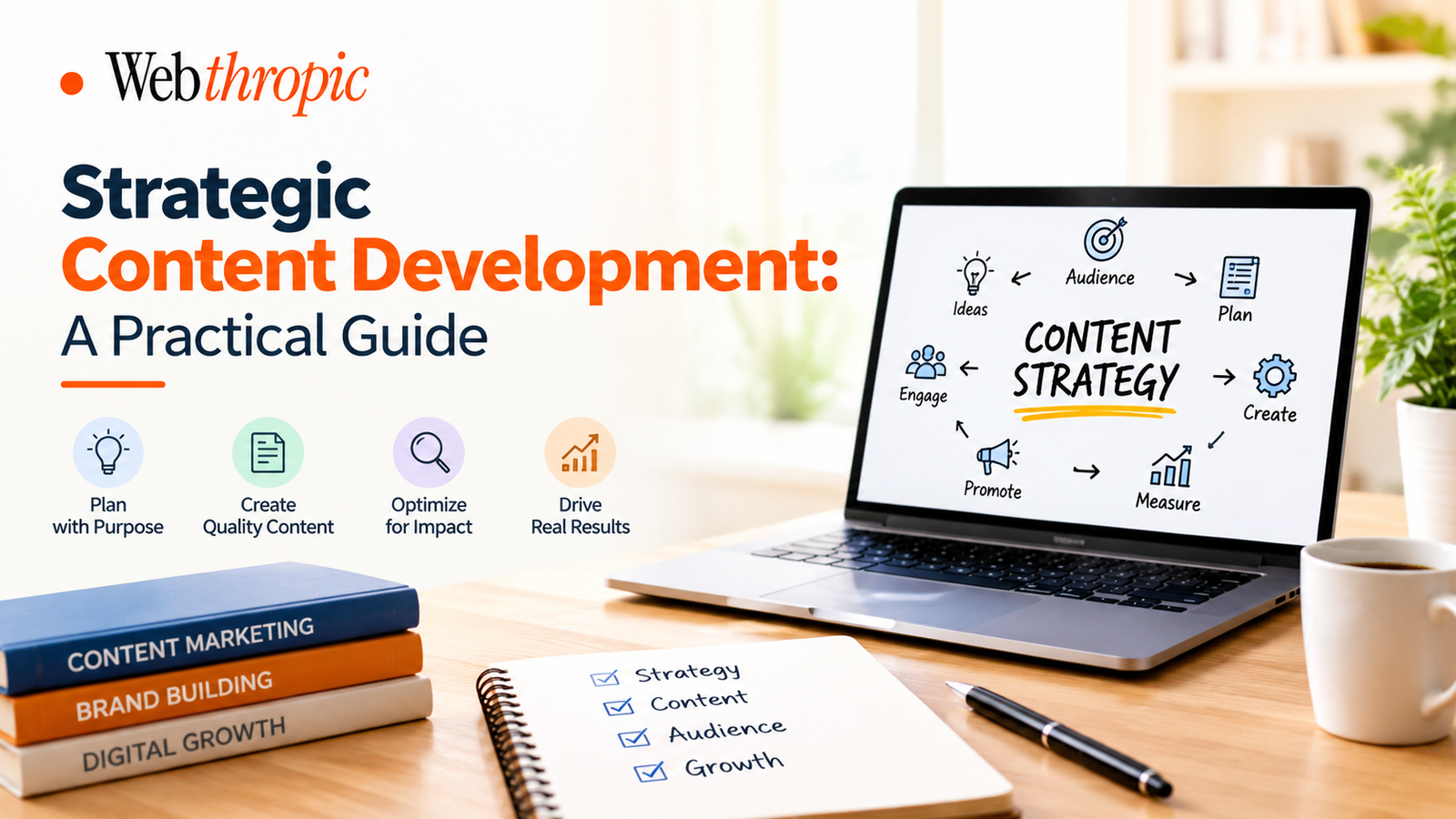
Strategic Content Development: A Practical Guide to Building Content That Drives Real Results
Every business today publishes content. Blog posts, videos, newsletters, social updates, and whitepapers pile up daily, yet most of it disappears without generating traffic, leads, or loyalty. The difference between content that works and content that gets ignored is rarely budget or talent. It is strategy.
Strategic content development is the disciplined process of planning, creating, distributing, and measuring content so that every piece supports a clear business goal and serves a defined audience. Instead of asking "What should we post this week?", it asks "What does our audience need, and how does that move our business forward?"
This guide explains what strategic content development involves, why it matters, and how to put it into practice.
What Is Strategic Content Development?
Strategic content development is a structured approach to content that connects three things: your business objectives, your audience's needs, and your content assets. It goes beyond writing good articles. It covers research, positioning, planning, production, promotion, and ongoing optimization.
Compare two approaches:
- Ad hoc content: Topics are chosen by whim or trend, publishing is irregular, and success is judged by gut feeling.
- Strategic content: Topics come from audience research and keyword data, publishing follows a calendar, and every piece has a goal and a metric.
The second approach compounds over time. Each piece builds on the last, strengthening your authority, search visibility, and audience trust.
Why Strategic Content Development Matters
1. It aligns content with business goals
Content without a goal is decoration. A strategic plan ties each asset to an outcome, whether that is brand awareness, lead generation, customer education, or retention.
2. It improves search visibility
Search engines reward content that is relevant, comprehensive, and consistently published. Strategic content development uses keyword research and topic clustering to help you rank for the questions your audience actually asks.
3. It builds trust and authority
People buy from brands they trust. Content that is accurate, useful, and consistent positions you as a reliable expert rather than just another seller.
4. It saves time and money
Planning reduces wasted effort. When you know your audience, goals, and formats in advance, you avoid producing content that never gets read.
5. It makes results measurable
With defined goals and KPIs, you can see what works, do more of it, and stop what doesn't.
The Core Components of a Strategic Content Development Plan
Step 1: Define clear goals
Start with the business outcome. Common content goals include:
- Increasing organic traffic
- Generating qualified leads
- Shortening the sales cycle
- Improving customer retention
- Establishing thought leadership
Make goals specific and measurable. "Grow organic traffic by 40% in six months" is far more useful than "get more visitors."
Step 2: Understand your audience
Strong content starts with deep audience knowledge. Build detailed audience personas that cover:
- Demographics and role: Who they are and what they do
- Pain points: The problems they are trying to solve
- Questions: What they search for and ask
- Preferred formats: Long articles, short videos, podcasts, or checklists
- Buying journey: Where they are in the awareness, consideration, and decision stages
Sources for this research include customer interviews, sales team feedback, survey responses, social media conversations, and search data.
Step 3: Conduct a content audit
Before creating anything new, review what you already have. A content audit helps you identify:
- High-performing pieces worth updating and promoting
- Outdated content that needs refreshing or removal
- Gaps where your audience's questions go unanswered
- Duplicate or competing pages that dilute your rankings
Often the fastest gains in strategic content development come from improving existing content rather than publishing more.
Step 4: Research keywords and topics
Keyword research reveals the language your audience uses and the demand behind each topic. Look beyond search volume and consider:
- Search intent: Is the person looking to learn, compare, or buy?
- Difficulty: Can you realistically rank for this term?
- Relevance: Does it connect to your products or expertise?
Group related keywords into topic clusters: a central "pillar" page covering a broad subject, supported by detailed articles on subtopics, all linked together. This structure signals depth and authority to search engines and helps readers navigate your site.
Step 5: Map content to the buyer's journey
Different audience stages need different content:
| Stage | Audience mindset | Content examples |
|---|---|---|
| Awareness | "I have a problem" | Blog posts, guides, infographics |
| Consideration | "What are my options?" | Comparisons, webinars, case studies |
| Decision | "Which one should I choose?" | Product demos, testimonials, pricing guides |
| Retention | "How do I get more value?" | Tutorials, newsletters, community content |
A balanced plan covers every stage so that you attract new visitors and also convert and keep them.
Step 6: Build an editorial calendar
A content calendar turns strategy into action. It should specify the topic, target keyword, format, author, deadline, publication date, and distribution channels for each piece. Consistency matters more than volume. Publishing one excellent article every week beats publishing five rushed ones sporadically.
Step 7: Create high-quality, valuable content
Quality is non-negotiable. Strong content is:
- Useful: It solves a real problem or answers a real question
- Original: It offers insight, data, or experience readers can't find everywhere else
- Well-structured: Clear headings, short paragraphs, and scannable formatting
- Accurate and credible: Backed by reliable sources and real expertise
- Actionable: Readers know what to do next
Write for people first and search engines second. Content that genuinely helps readers tends to perform well in search anyway.
Step 8: Distribute and promote
Publishing is only half the job. Share content through:
- Email newsletters to nurture existing subscribers
- Social media tailored to each platform's style
- Partnerships and guest contributions to reach new audiences
- Internal linking to keep readers exploring your site
- Repurposing, such as turning a blog post into a video, infographic, or short social series
Step 9: Measure, learn, and optimize
Track the metrics tied to your original goals:
- Traffic metrics: Sessions, organic visits, new vs. returning users
- Engagement metrics: Time on page, scroll depth, comments, shares
- Conversion metrics: Sign-ups, downloads, demo requests, sales
- SEO metrics: Rankings, impressions, click-through rate, backlinks
Review performance regularly, usually monthly or quarterly. Update what is underperforming, double down on what works, and refine your plan accordingly.
Common Mistakes to Avoid
Even well-intentioned teams stumble. Watch for these pitfalls in your strategic content development:
- Skipping audience research. Guessing what people want leads to content nobody needs.
- Chasing trends instead of goals. Not every viral topic fits your brand or business.
- Prioritizing quantity over quality. Thin, repetitive content harms credibility and rankings.
- Neglecting distribution. Great content fails if no one sees it.
- Ignoring existing content. Refreshing old posts is often more efficient than starting from scratch.
- Failing to measure. Without data, you can't improve.
- Inconsistent voice. A recognizable brand tone builds familiarity and trust.
Tools That Support Strategic Content Development
The right tools make the process more efficient:
- Keyword and SEO tools such as Google Search Console, Ahrefs, Semrush, or Google Keyword Planner
- Analytics platforms like Google Analytics for tracking behavior and conversions
- Project management tools such as Trello, Asana, or Notion for editorial workflows
- Content optimization tools to improve structure, readability, and relevance
- Design tools like Canva or Figma for visuals
Tools support strategy, but they cannot replace it. Clear thinking and audience understanding come first.
Building a Sustainable Content Engine
The best content programs are not sprints but systems. To sustain strategic content development over the long term:
- Document your strategy so everyone understands the goals, audience, and voice.
- Create templates and guidelines to maintain consistency and speed up production.
- Involve subject matter experts to add depth and authenticity.
- Collect feedback from customers, sales, and support teams to uncover new topics.
- Revisit your strategy at least twice a year as markets, audiences, and algorithms evolve.
Final Thoughts
Content is one of the few marketing assets that keeps working long after it is published. But only a thoughtful approach turns it from noise into a growth engine. Strategic content development gives you that approach: clear goals, deep audience insight, purposeful planning, quality execution, smart distribution, and continuous improvement.
Start small. Define one goal, understand one audience segment, and build one topic cluster around it. Measure the results, learn from them, and expand. Over time, those deliberate steps add up to a content library that attracts the right people, earns their trust, and supports real business growth.
If you want this as a Word or Markdown file, or tuned for a specific industry or audience, I can do that.
