PPC Advertising Strategies for Indian Businesses: A Complete Guide
Practical PPC Strategies to Improve Google Ads Performance, Generate Leads, and Grow Your Business
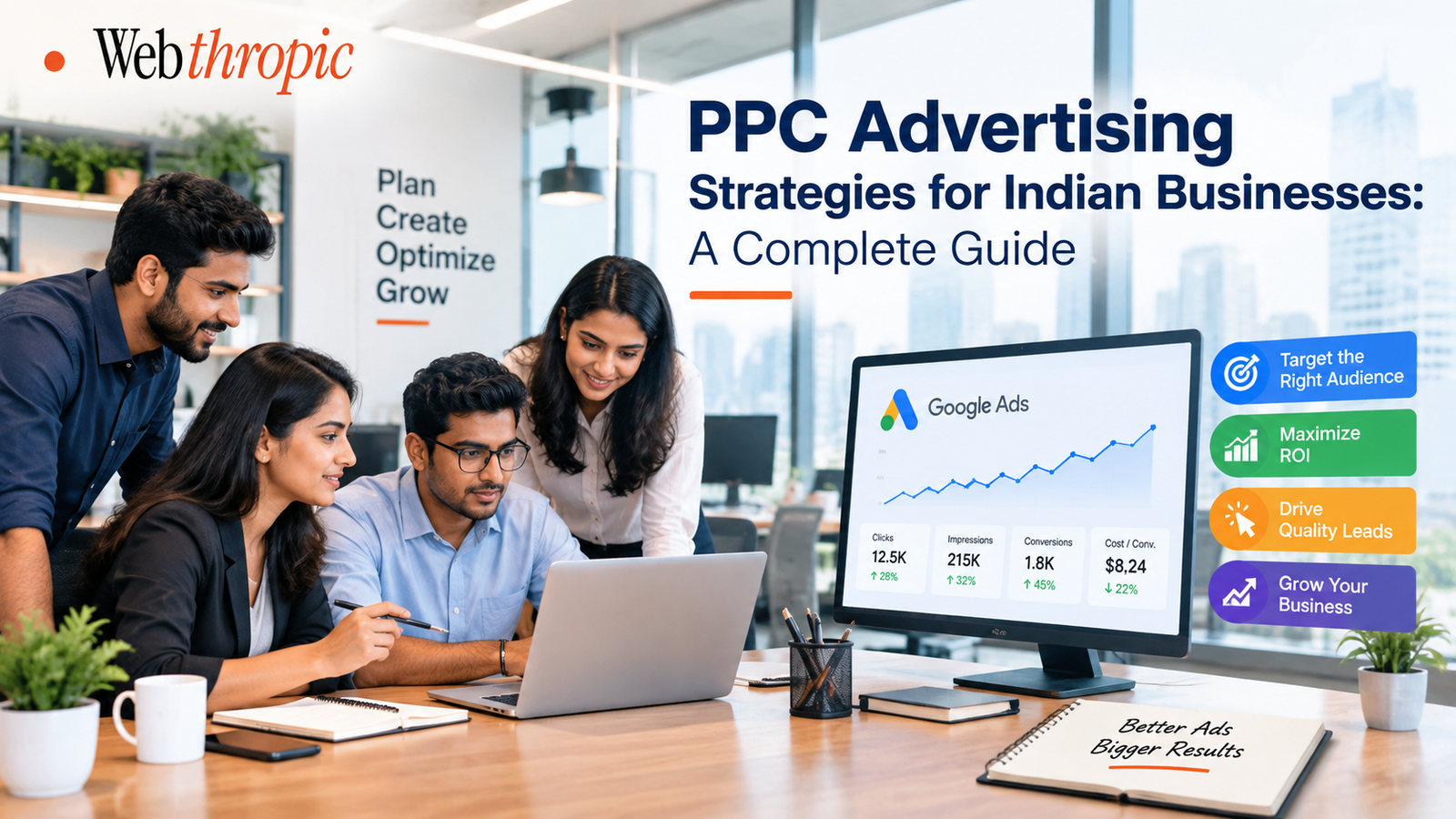
In today's competitive digital marketplace, businesses need effective ways to reach potential customers, generate qualified leads, and increase sales. Pay-per-click (PPC) advertising is one of the most practical digital marketing methods for achieving these goals.
It allows businesses to display paid advertisements to relevant audiences and pay when users click on their ads, depending on the advertising model. For Indian businesses, PPC advertising offers opportunities to target customers by location, search intent, interests, and other relevant audience signals.
Whether you operate a local service business, a startup, a B2B company, or an e-commerce store, a well-planned paid advertising campaign can help you reach potential customers more efficiently.
However, successful PPC advertising requires more than launching an advertisement and setting a budget. Businesses need the right keywords, compelling ad copy, appropriate audience targeting, conversion-focused landing pages, and regular performance analysis.
This guide explores the most effective PPC advertising strategies for Indian businesses and explains how to build campaigns that support sustainable business growth.
What Is PPC Advertising?
PPC advertising is a digital advertising model in which advertisers typically pay when someone clicks on their advertisement. Google Ads is a widely used PPC platform, while Meta Ads, Microsoft Advertising, and LinkedIn Ads offer additional opportunities to reach potential customers.
Businesses can use PPC campaigns to achieve several objectives, including:
- Generating qualified leads and enquiries.
- Increasing website traffic.
- Promoting products and services.
- Driving online purchases.
- Increasing brand awareness.
- Encouraging phone calls, bookings, and consultations.
For example, a company offering website development services in India could target searches related to business website design, e-commerce development, or custom web applications. Relevant advertisements can direct interested users to dedicated service pages where they can request a quotation or schedule a consultation.
The key is to align the advertising campaign with a clear business objective rather than focusing only on clicks or impressions.
Why PPC Advertising Matters for Indian Businesses
India's diverse digital market creates opportunities for businesses of different sizes and industries. PPC campaigns can help companies reach specific customer groups without relying exclusively on organic search visibility.
Here are some important advantages.
1. Faster visibility: Paid search advertisements can appear prominently in search results when campaigns are eligible and meet the relevant auction requirements.
2. Targeted reach: Businesses can refine targeting by geographic area, language, device, audience characteristics, and search intent, depending on the platform and campaign type.
3. Budget control: Advertisers can set campaign budgets and monitor spending to manage advertising costs.
4. Measurable performance: Tracking clicks, leads, purchases, and revenue helps businesses understand whether their campaigns are contributing to business goals.
5. Flexible campaigns: Advertisers can test different keywords, messages, offers, locations, and landing pages to identify better-performing approaches.
Nevertheless, PPC results are not guaranteed. Competition, advertising costs, website quality, product demand, and campaign management all influence performance.
10 PPC Advertising Strategies for Indian Businesses
1. Choose High-Intent Keywords
Keyword research is the foundation of an effective PPC campaign. Instead of targeting every keyword related to your business, focus on search terms that indicate a genuine interest in purchasing a product or service.
For example, a web development company could target:
- Website development company in India
- Affordable e-commerce website development
- Custom web application development services
- Business website design company
- Hire a website development agency
These keywords communicate different levels of buying intent. A search for “what is website development” is usually informational, whereas “hire a website development company” suggests stronger commercial intent.
Use Google Keyword Planner to research search terms, estimated costs, and competition. Organize keywords into closely related groups so that your ads and landing pages match what users are searching for.
2. Use Location-Based Advertising
Location targeting is especially valuable for Indian businesses serving specific cities, states, or regions.
For example, a digital marketing agency could create separate campaigns for Delhi NCR, Mumbai, Bengaluru, Kolkata, and other locations where it wants to attract clients.
Effective location-based PPC strategies include:
- Targeting cities where your business can deliver services.
- Using city-specific keywords when appropriate.
- Creating dedicated landing pages for important service areas.
- Reviewing location reports to identify areas generating qualified leads.
- Excluding locations that consistently produce irrelevant traffic.
Businesses should also consider language preferences. Depending on the target audience, advertisements in English, Hindi, or relevant regional languages may help communicate the offer more effectively.
Pro tip: Do not target all of India automatically if your business only serves a few cities. Begin with locations that match your service capacity and customer profile.
3. Write Compelling Ad Copy
Your advertisement should immediately communicate what you offer, why it matters, and what users should do next.
A strong PPC advertisement typically includes a relevant headline, a clear value proposition, a credible differentiator, and a specific call to action.
For example:
SAMPLE GOOGLE SEARCH AD
Professional Website Development Services
- webthropic.com
- Build a modern, mobile-friendly website tailored to your business goals. Explore custom solutions for your brand.
- Responsive Websites
- Custom Solutions
- Business-Focused Design
- Request a Consultation Today
Test different headlines, benefits, and calls to action to discover which combinations attract qualified prospects. Avoid unsupported claims, misleading discounts, and promises that your business cannot fulfil.
4. Create Dedicated Landing Pages
Sending every advertisement to your homepage can reduce campaign effectiveness because visitors may struggle to find the exact service they want.
Instead, create dedicated landing pages for individual services, product categories, or campaigns.
A high-converting landing page should include:
- A headline matching the advertisement.
- A clear explanation of the service or product.
- Benefits and relevant differentiators.
- Customer reviews or other genuine trust signals.
- A simple enquiry form or purchase process.
- Click-to-call or WhatsApp contact options where appropriate.
- Fast loading speed and a mobile-friendly layout.
For example, an advertisement targeting “Google Ads management services” should direct visitors to a PPC management page rather than a general digital marketing homepage.
The closer the connection between the search query, ad copy, and landing page, the easier it is for visitors to understand the offer. Landing page experience also contributes to Google's Quality Score assessment.
5. Manage Negative Keywords
Negative keywords help prevent your advertisements from appearing for searches that are irrelevant to your business.
Suppose you provide paid website development services. You may want to exclude searches related to free website templates, jobs, salaries, internships, or training courses if those searches do not match your offer.
Potential negative keywords include:
- Free
- Jobs
- Salary
- Internship
- Course
- Tutorial
- Download
These are examples, not a universal exclusion list. A training provider, for instance, might want to target “course,” while a company offering free trials may not want to exclude “free.”
Review your search-term reports regularly. Add exclusions based on actual irrelevant queries, and avoid blocking terms that could represent valuable customers. Google explains that negative keywords can help advertisers exclude unwanted searches.
6. Select the Right PPC Platform
Different advertising platforms support different business objectives. Indian businesses should choose channels according to customer behaviour, campaign goals, and the type of product or service being promoted.
| Platform | Best suited for |
| Google Search Ads | Reaching people actively searching for a solution |
| Google Shopping Ads | Promoting eligible e-commerce product listings |
| YouTube Ads | Video-based awareness and consideration |
| Meta Ads | Visual discovery, offers, and audience engagement |
| LinkedIn Ads | B2B marketing and professional audience targeting |
| Google Display Ads | Visual reach and suitable remarketing campaigns |
Google offers multiple campaign formats for search, shopping, video, display, and other advertising objectives.
For a local service company, Search Ads may be a practical starting point. For an online retailer, Shopping campaigns could be useful. A business selling products that customers discover through visual content may also benefit from Meta or YouTube advertising.
Rather than investing in every platform at once, start with the channels most closely aligned with your target audience.
7. Set a Realistic PPC Budget
An effective PPC budget depends on your industry, competition, location, average order value, customer acquisition costs, and conversion rate.
Before setting your budget, estimate:
- How much you can afford to spend monthly.
- The approximate cost per click for relevant keywords.
- The number of clicks your budget may generate.
- Your expected conversion rate.
- The maximum acceptable cost per qualified lead or sale.
For example, suppose an illustrative campaign has a monthly advertising budget of ₹30,000 and an average cost per click of ₹30.
| Metric | Illustrative estimate |
| Monthly ad budget | ₹30,000 |
| Average cost per click | ₹30 |
| Estimated clicks | 1,000 |
| Assumed conversion rate | 3% |
| Estimated conversions | 30 |
| Advertising cost per conversion | ₹1,000 |
These figures are hypothetical, not a forecast or industry benchmark. Actual performance can vary significantly, and a form submission is not necessarily a qualified lead or paying customer.
Use initial campaign data to refine your budget. Increase spending only when the campaign produces results that justify the additional investment.
8. Use Conversion Tracking and Smart Bidding
Clicks alone do not reveal whether a campaign is generating business value. Conversion tracking helps measure actions such as completed enquiries, purchases, phone calls, and other meaningful outcomes.
Before launching a campaign, configure the appropriate tracking through Google Ads, Google Analytics, or Google Tag Manager, as applicable.
Once tracking is reliable, evaluate bidding strategies that align with your objectives.
- Maximize Clicks: Can help generate website visits when traffic is the main objective.
- Maximize Conversions: Aims to generate more tracked conversions within the available budget.
- Target CPA: Helps optimize towards a specified average cost per acquisition.
- Target ROAS: Helps optimize conversion value relative to advertising spend when suitable revenue tracking is available.
The availability and suitability of bidding options depend on campaign type and account setup. Automated bidding works best when the conversion actions being measured reflect meaningful business outcomes.
For example, a company generating enquiries should distinguish genuine prospective customers from spam submissions and low-quality leads wherever its tracking setup allows.
9. Use Remarketing to Reconnect with Potential Customers
Not every visitor makes a purchase or submits an enquiry during their first visit. Remarketing can help businesses reconnect with eligible audiences who have previously interacted with their website or brand.
Potential remarketing approaches include:
- Showing relevant product ads to eligible past visitors.
- Reminding interested users about services they explored.
- Promoting a suitable offer to users who abandoned a purchase.
- Sharing helpful content with audiences who have engaged with the brand.
For example, an e-commerce business could show eligible visitors advertisements featuring products they previously viewed.
Use appropriate consent, privacy disclosures, platform policies, and audience eligibility requirements. Avoid excessive ad frequency and make sure the message remains relevant to the audience.
10. Review Campaign Performance Every Week
PPC optimization should be an ongoing process. Regular analysis helps identify wasted spending, weak advertisements, and opportunities to improve conversion quality.
Monitor these key performance indicators:
| KPI | What it tells you |
| Click-through rate (CTR) | How often impressions lead to clicks |
| Cost per click (CPC) | Average cost of each click |
| Conversion rate | Percentage of clicks that convert |
| Cost per lead (CPL) | Advertising cost per lead |
| Cost per acquisition (CPA) | Cost of acquiring a defined customer or conversion |
| Return on ad spend (ROAS) | Tracked revenue relative to advertising spend |
Do not optimize campaigns based on CTR or CPC alone. A campaign with inexpensive clicks may still perform poorly if those visitors do not become customers.
Review search terms, conversion quality, landing page performance, and sales outcomes together. This gives you a more complete picture of campaign profitability.
Common PPC Mistakes Indian Businesses Should Avoid
Even a well-funded campaign can underperform when the basics are overlooked. Avoid these common mistakes:
- Targeting overly broad keywords: Focus on relevant search intent and expand targeting carefully.
- Ignoring negative keywords: Exclude irrelevant queries based on search-term data.
- Using one landing page for every service: Match each campaign to a relevant destination.
- Launching without conversion tracking: Establish reliable measurement before spending heavily.
- Targeting unsuitable locations: Align geographic targeting with your actual service area.
- Changing campaigns too frequently: Allow sufficient time and data to evaluate performance.
- Measuring only clicks: Prioritize qualified leads, purchases, revenue, and profitability.
- Ignoring mobile users: Check page speed, readability, forms, and contact options on mobile devices.
Avoiding these mistakes can make your advertising budget more accountable and your optimization decisions more informed.
How Webthropic Can Help Your Business Grow with PPC Advertising
Managing paid advertising requires a clear strategy, audience understanding, compelling creative, and consistent performance analysis.
Webthropic helps businesses strengthen their digital presence through services such as website development, SEO, digital marketing, and business growth solutions. A properly structured PPC campaign can complement these services by helping businesses reach relevant audiences and generate measurable enquiries.
Businesses looking to improve their paid advertising can benefit from a strategy that focuses on:
- Campaign planning based on business objectives.
- Keyword research and audience targeting.
- Relevant ad copy and landing page recommendations.
- Conversion tracking and performance reporting.
- Ongoing campaign analysis and optimization.
The goal should be to attract the right audience, improve lead quality, and make better use of the advertising budget rather than simply increasing website traffic.
Explore Webthropic's digital marketing services to learn more about building a stronger online presence.
Frequently Asked Questions
1. What is PPC advertising in digital marketing?
PPC advertising is a paid advertising model in which advertisers generally pay when users click on their advertisements. It helps businesses attract targeted traffic, generate enquiries, promote products, and increase sales.
2. Which PPC platform is best for Indian businesses?
Google Ads can be effective for businesses targeting customers who actively search for their products or services. Meta Ads may be suitable for visual discovery and audience engagement, while LinkedIn Ads can be useful for certain B2B campaigns. The best choice depends on the target audience and business objective.
3. How much does PPC advertising cost in India?
There is no fixed PPC cost for every business. Advertising costs depend on competition, keyword selection, audience targeting, location, and campaign quality. Businesses should establish a budget based on their financial capacity and acceptable customer acquisition cost.
4. How can I improve PPC campaign performance?
Improve campaign performance through relevant keyword targeting, effective ad copy, suitable landing pages, negative keyword management, reliable conversion tracking, and regular analysis of qualified leads or sales.
5. Is PPC better than SEO?
PPC and SEO serve different purposes. PPC can provide paid visibility while a campaign is active, whereas SEO focuses on improving organic visibility over time. Combining both strategies can help businesses reach potential customers through paid and organic search.
6. How long does it take to see PPC results?
Advertisements may begin receiving impressions and clicks after approval and launch, but meaningful performance evaluation takes longer. The time needed to assess lead quality, conversions, and profitability depends on the campaign, budget, sales cycle, and available data.
Conclusion
PPC advertising can help Indian businesses reach potential customers, generate qualified leads, and support online sales when campaigns are planned and managed carefully.
The most effective approach combines high-intent keyword research, location-based targeting, persuasive ad copy, relevant landing pages, negative keywords, conversion tracking, and ongoing optimization. Businesses should also evaluate lead quality and profitability instead of relying solely on traffic metrics.
Start with a clear objective, test your strategy with a manageable budget, and use performance data to guide improvements. With a consistent approach, PPC advertising can become a valuable part of your broader digital marketing strategy.
Ready to improve your online visibility and attract more potential customers? Explore Webthropic's digital marketing solutions and take the next step towards sustainable business growth.