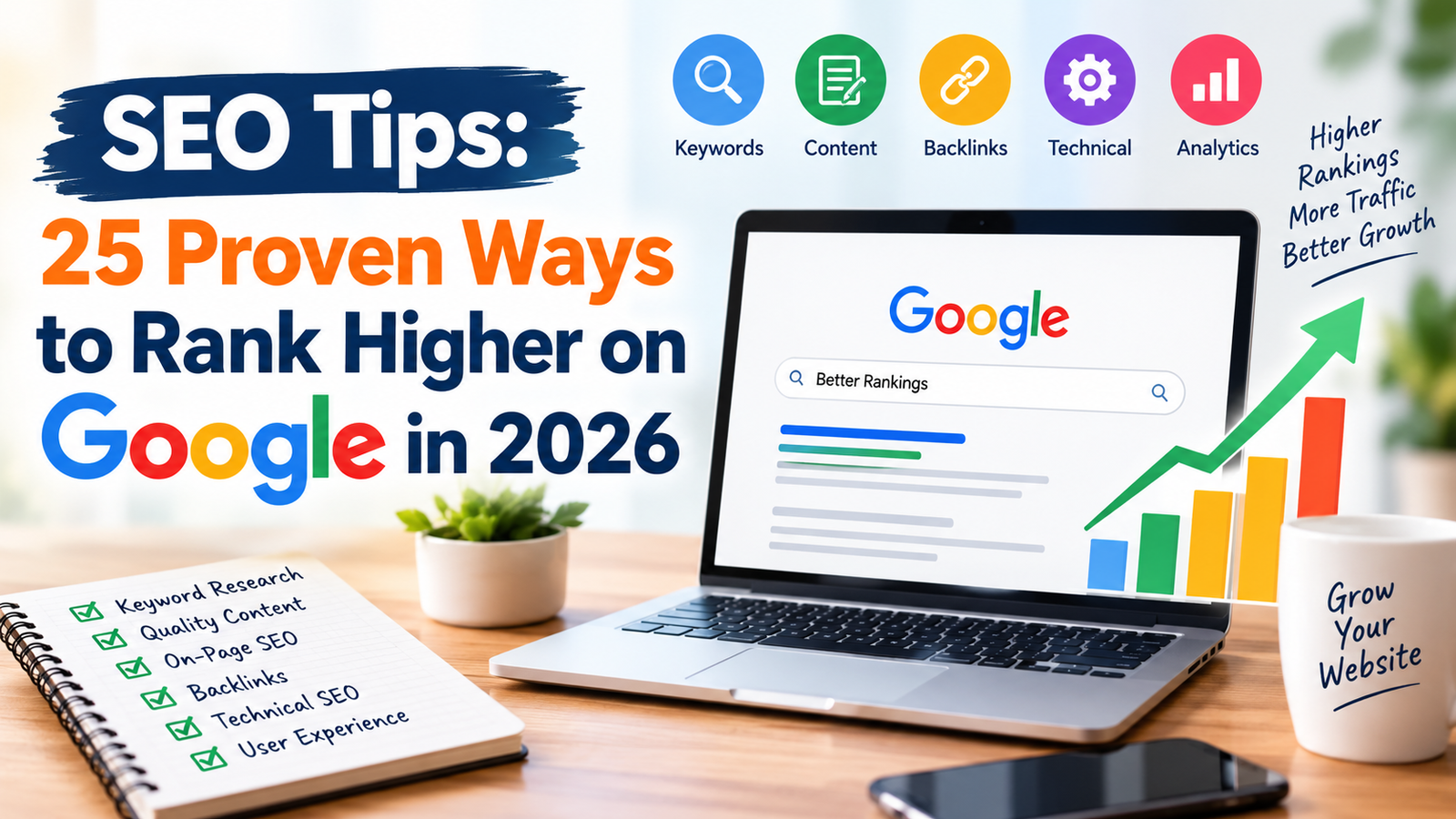
SEO Tips: 25 Proven Ways to Rank Higher on Google in 2026
25 Actionable SEO Tips to Improve Google Rankings, Organic Traffic, and Website Performance
If you want more organic traffic, better Google rankings, and more leads from your website, these practical SEO tips will help you build a strong foundation. Search engine optimization is not about tricks; it is about creating useful content, improving website performance, and making it easy for both users and search engines to understand your pages.
This guide is written for website owners, bloggers, small businesses, developers, and beginners. If you need a fast, SEO-friendly website for your business, explore our website development services. You will learn on-page SEO, technical SEO, keyword research, content writing, local SEO, ecommerce SEO, YouTube SEO, and link-building tips in one place.
SEO Tips for Beginners: Start With Search Intent
SEO tips for beginners should always begin with search intent. Before writing any page, ask: what does the searcher actually want—an answer, a comparison, a tutorial, a product, or a local service?
For example, someone searching “seo tips for beginners” wants simple, actionable advice. Someone searching “best website development company in Bihar” wants service providers, pricing, and contact options. Matching content to intent improves engagement and helps Google understand that your page solves the user’s problem.
Start with these basics:
- Choose one primary keyword per page.
- Add supporting keywords naturally in headings and body content.
- Answer the searcher’s question early in the article.
- Use simple language and clear formatting.
- Add a call to action, such as “Get a free website audit” or “Contact us for website development.”
Keyword Research Tips: Find Keywords You Can Rank For
Keyword research tips help you choose topics with real search demand. Use Google Keyword Planner, Ubersuggest, Ahrefs, Semrush, or Google Search Console to check search volume, competition, and related queries.
For a website development business, useful keyword groups include:
- website development services
- website design and development
- SEO tips for small businesses
- WordPress website development
- ecommerce website development
- local SEO tips
- website optimization services
Do not target only high-volume keywords. A keyword such as “seo tips” may have high volume, but long-tail keywords like “seo tips for new websites” or “seo tips for WordPress websites” are often easier to rank for and bring more qualified visitors.
Create a simple keyword map:
| Page type | Primary keyword | Supporting keywords |
|---|---|---|
| Homepage | website development services | website design, web development company |
| Service page | WordPress website development | WordPress developer, custom WordPress website |
| Blog post | seo tips | seo optimization tips, google ranking tips |
| Local page | website development in Patna | web design Patna, website designer near me |
On Page SEO Tips: Optimize Every Important Element
On page SEO tips focus on elements you control directly on each web page: titles, headings, content, URLs, images, internal links, and metadata. Strong on-page optimization helps search engines understand the topic and purpose of your page.
Use this checklist:
- Put your main keyword in the title tag, ideally near the beginning.
- Use one clear H1 that matches the page topic.
- Break content into H2 and H3 subheadings.
- Write a unique meta description of about 140–160 characters.
- Keep URLs short, lowercase, and keyword-focused.
- Use the primary keyword in the first 100 words.
- Add related keywords naturally; do not force them.
- Include internal links to relevant service or blog pages.
- Add descriptive alt text to images.
- Update old content when information changes.
For this article, the primary keyword is “seo tips.” It appears in the title, URL, introduction, and several subheadings, while related terms such as “seo optimization tips,” “google ranking tips,” and “website seo tips” support the topic naturally.
SEO Content Writing Tips: Write for Humans First
SEO content writing tips are useless if the content does not help real people. Google increasingly rewards pages that demonstrate experience, expertise, helpfulness, and trust.
Write content that is:
- Original and specific
- Easy to scan
- Free from unnecessary fluff
- Supported by examples, screenshots, or data
- Updated regularly
- Structured with headings, bullet points, and short paragraphs
A good structure is: introduction, problem, solution, steps, examples, FAQs, and conclusion. Use your target keyword in the title and opening paragraph, then use semantic variations throughout the article.
For example, instead of writing “SEO is important,” write: “SEO helps your website appear when customers search for services such as website development, WordPress design, or local business solutions.”
Website SEO Tips: Improve Site Structure and Navigation
Website SEO tips should focus on making your entire website easy to crawl and navigate. A clean structure helps users find information quickly and helps search engines discover all important pages.
Follow these rules:
- Keep every important page within three clicks of the homepage.
- Use a simple menu: Home, Services, Portfolio, Blog, About, Contact.
- Create category pages for services such as website design, ecommerce development, and SEO.
- Avoid orphan pages with no internal links.
A well-structured website improves both user experience and search visibility. Our website development services focus on clean navigation, mobile-friendly design, and SEO-ready page structure.
- Use breadcrumbs on blogs and ecommerce websites.
- Link related blog posts to relevant service pages.
For a website development company, link a blog post about “SEO tips” to service pages such as “Website Development Services,” “WordPress Development,” and “Ecommerce Website Design.”
Technical SEO Tips: Fix Crawlability and Speed Issues
Technical SEO tips are essential because even excellent content may not rank if Google cannot crawl, index, or load your website properly. Fix technical issues before publishing large amounts of new content.
Check these items:
- Submit an XML sitemap in Google Search Console.
- Use HTTPS across the entire website.
- Fix broken links and redirect errors.
- Remove duplicate content using canonical tags.
- Create a mobile-friendly responsive design.
- Improve Core Web Vitals and page speed.
Slow hosting, heavy plugins, and unoptimized images can reduce rankings and conversions. You can improve performance with professional website speed optimization.
- Use clean, descriptive URLs.
- Add structured data where relevant.
- Check that important pages are indexed.
Page speed matters because slow websites frustrate users and can reduce conversions. Compress images, use caching, minimize unnecessary scripts, and choose reliable hosting.
Google Ranking Tips: Focus on Experience and Authority
Google ranking tips often change, but the core principle remains the same: Google wants to show the most helpful, trustworthy result. Your website should prove that it deserves to rank.
To improve rankings:
- Publish detailed content around one main topic.
- Build topical clusters with a pillar page and related articles.
- Earn mentions and links from relevant websites.
- Keep your business information consistent across the web.
- Refresh outdated posts every few months.
- Monitor rankings and clicks in Google Search Console.
For example, your “SEO tips” pillar post can link to smaller articles on keyword research, meta descriptions, WordPress SEO, local SEO, and ecommerce SEO. This hub-and-spoke structure builds topical authority.
Blog SEO Tips: Create Articles That Bring Traffic
Blog SEO tips are especially useful for website development companies because blogs attract people searching for solutions before they are ready to hire someone.
Good blog topics include:
- How much does a website cost in India?
- WordPress vs custom website development
- Best SEO tips for small businesses
- How to improve website speed
- Local SEO tips for service businesses
- Ecommerce website development checklist
Each blog post should target one main keyword and link to a relevant service page. A blog post about SEO tips can naturally lead readers to your website audit, SEO service, or website development service.
Use these blog SEO practices:
- Add the keyword in the title, H1, URL, and first paragraph.
- Use FAQs to capture long-tail searches.
- Add original images with alt text.
- Include a clear next step at the end.
- Update posts with new examples and statistics.
Meta Description Tips: Write Click-Worthy Descriptions
Meta description tips matter because a good description can improve click-through rate even if it does not directly control rankings. Write a benefit-driven summary that tells users why they should click.
A strong meta description should:
- Be around 140–160 characters
- Include the main keyword naturally
- Explain what the reader will learn
- Include a benefit or result
- End with a soft call to action
Example:
Learn 25 practical SEO tips to improve website rankings, increase organic traffic, and attract more customers. Ideal for beginners, bloggers, and small businesses.
Alt Tag SEO Best Practices: Optimize Images Correctly
Alt tag SEO best practices improve accessibility and help Google understand images. Alt text should describe the image clearly, not just repeat keywords.
Good alt text examples:
- alt="SEO tips checklist for website optimization"
- alt="WordPress website development dashboard"
- alt="Local SEO Google Business Profile optimization example"
Avoid writing:
- alt="SEO SEO SEO image"
- alt="image1"
- alt="click here"
Use descriptive file names too, such as seo-tips-checklist.webp instead of IMG_1234.jpg.
Internal Linking Tips: Connect Related Pages Strategically
Internal linking tips help distribute authority across your website and guide visitors toward important pages. Use descriptive anchor text instead of generic phrases like “click here.”
For example:
- Link “SEO tips” to your SEO service page.
- Link “WordPress website development” to your WordPress service page.
- Link “ecommerce website development” to your ecommerce service page.
- Link “local SEO tips” to your local SEO service page.
Do not add too many links in one paragraph. Add links only where they genuinely help the reader understand the next step.
Link Building Tips: Earn Authority the Right Way
Link building tips should focus on earning relevant, high-quality backlinks rather than buying spammy links. Backlinks from trusted websites can improve authority, but relevance matters more than raw quantity.
Effective methods include:
- Guest posting on relevant industry blogs
- Creating useful resources, templates, and checklists
- Getting listed in credible local business directories
- Turning unlinked brand mentions into links
- Publishing original research or case studies
- Building relationships with bloggers, journalists, and local businesses
Avoid automated link schemes, paid link networks, and irrelevant directory spam. These can harm your website instead of helping it.
Local SEO Tips: Get Found by Nearby Customers
Local SEO tips are essential if your website development business serves a specific city or region. Optimize your Google Business Profile and make your location information consistent everywhere online.
Do the following:
Create and verify your Google Business Profile.
Local SEO works best when your website, Google Business Profile, and service pages send consistent signals. Learn more about our local SEO services.
- Use the same business name, address, and phone number everywhere.
- Add service areas, photos, working hours, and website links.
- Collect genuine customer reviews.
- Publish location-based pages only where you actually serve customers.
- Add local schema markup where appropriate.
For example, a page titled “Website Development Services in Patna” should include local examples, service areas, testimonials, and contact details—not copied content from another city page.
Google My Business SEO Tips: Optimize Your Business Profile
Google My Business SEO tips can help local businesses appear in Google Maps and local search results. Your profile should be complete, accurate, and active.
Optimize it by:
- Choosing the correct primary category
- Adding secondary categories
- Writing a keyword-rich but natural business description
- Uploading real photos of your office, team, and work
- Posting updates about services and offers
- Responding to every review professionally
- Adding products, services, and booking links
A website development company can add services such as “Website Design,” “WordPress Development,” “Ecommerce Development,” and “SEO Services.”
SEO Tips for Small Businesses: Prioritize High-Impact Actions
SEO tips for small businesses should focus on actions that bring the fastest measurable results. Small businesses usually do not need hundreds of pages; they need a few strong pages that convert.
Prioritize:
- A fast, mobile-friendly website.
- Clear service pages.
- A Google Business Profile.
- Local customer reviews.
- Helpful blog content.
- Strong calls to action.
- Accurate contact information.
- Regular performance tracking.
Instead of trying to rank for every keyword, target keywords that show buying intent, such as “website development services,” “WordPress developer near me,” or “SEO services for small business.”
Ecommerce SEO Tips: Optimize Product and Category Pages
Ecommerce SEO tips help online stores attract buyers who are ready to purchase. Product pages need more than images and prices; they need useful, unique content.
Improve ecommerce SEO by:
- Writing unique product descriptions.
- Using customer reviews.
- Adding clear product images and alt text.
- Creating useful category page content.
- Fixing duplicate product URLs.
- Using structured data for products, prices, and availability.
- Improving checkout speed and mobile usability.
- Linking related products and blog guides.
For Shopify, WooCommerce, Etsy, Amazon, and eBay stores, focus on search intent. A buyer searching “best SEO tips for Shopify store” needs practical store-optimization advice, while someone searching “buy WordPress theme” is closer to a purchase decision.
WordPress SEO Tips: Use Plugins Wisely
WordPress SEO tips are important because WordPress is flexible but can become slow or complicated without proper setup. Use an SEO plugin such as Yoast SEO or Rank Math to manage titles, meta descriptions, sitemaps, and schema.
Follow these practices:
- Use a lightweight theme.
- Remove unused plugins.
- Compress and lazy-load images.
- Enable caching.
- Use SEO-friendly permalinks.
- Create XML sitemaps.
- Add internal links between posts and pages.
- Keep WordPress, themes, and plugins updated.
Do not install too many plugins. Each additional plugin can add code, slow down the website, and create security risks.
YouTube SEO Tips: Rank Videos and Grow Your Channel
YouTube SEO tips help your videos appear in YouTube search and Google video results. Video SEO depends on clear titles, descriptions, thumbnails, watch time, and engagement.
For better YouTube rankings:
- Use a keyword-rich video title.
- Write a detailed description with timestamps.
- Add relevant tags and hashtags.
- Design a clear, high-contrast thumbnail.
- Ask viewers to like, comment, and subscribe.
- Create playlists around one topic.
- Add captions or transcripts.
- Embed videos in related blog posts.
A website development company can create videos such as “SEO Tips for New Websites,” “WordPress Website Tutorial,” or “How to Improve Website Speed.”
SEO Tips for New Websites: Build Momentum Step by Step
SEO tips for new websites should focus on fundamentals before chasing competitive keywords. A new domain needs time to build trust, content depth, and authority.
In the first 90 days:
- Set up Google Search Console and Google Analytics.
- Fix technical SEO issues.
- Create core service pages.
- Publish 8–12 helpful blog posts.
- Build internal links.
- Create a Google Business Profile.
- Start earning local citations and reviews.
- Track keyword rankings and clicks.
Do not expect overnight results. Consistent publishing, technical maintenance, and genuine promotion produce more sustainable growth than shortcuts.
Free SEO Tips: Improve Rankings Without a Big Budget
Free SEO tips are valuable for startups and small businesses with limited marketing budgets. You can improve many ranking factors without paid tools.
Free actions include:
- Use Google Search Console for indexing and keyword data.
- Use Google Analytics for traffic insights.
- Check page speed with PageSpeed Insights.
- Use Google Business Profile for local visibility.
- Answer questions on relevant forums and communities.
- Repurpose blog content into social posts and videos.
- Update old articles instead of always creating new ones.
These actions cost time rather than money, but they can significantly improve organic performance.
Advanced SEO Tips: Scale After the Basics
Advanced SEO tips become useful once your website has solid content, technical health, and some authority. At this stage, focus on topical authority, content refreshes, and conversion optimization.
Advanced strategies include:
- Build pillar-cluster content models.
- Conduct content gap analysis against competitors.
- Refresh pages that rank on page two.
- Improve internal linking to money pages.
- Add FAQ, Article, Product, and LocalBusiness schema.
- Optimize for people also ask and featured snippets.
- Test headlines, layouts, and calls to action.
- Track conversions, not just traffic.
Traffic alone is not enough. A website should turn visitors into leads, calls, bookings, or sales.
Common SEO Mistakes to Avoid
Avoid these mistakes because they can waste months of effort:
- Targeting too many keywords on one page.
- Copying competitor content.
- Ignoring mobile users.
- Publishing thin or duplicate pages.
- Using keyword stuffing.
- Buying low-quality backlinks.
- Ignoring page speed.
- Forgetting internal links.
- Not tracking results.
- Leaving old content outdated.
SEO works best when content quality, technical performance, and user experience improve together.
FAQs About SEO Tips
What are the best SEO tips for beginners?
Start with search intent, keyword research, strong titles, helpful content, fast loading speed, mobile-friendly design, and internal linking. These basics create a strong SEO foundation.
How long does SEO take to work?
Most websites begin seeing meaningful progress in three to six months, though competitive keywords can take longer. Results depend on competition, content quality, domain authority, and technical health.
How many SEO keywords should I use on one page?
Use one primary keyword per page and several related keywords naturally. Avoid forcing dozens of keywords into the same article.
Do meta descriptions affect Google rankings?
Meta descriptions do not directly control rankings, but they can improve click-through rate by encouraging more users to visit your page.
Are SEO tips different for WordPress, Shopify, and Etsy?
The core principles are the same, but implementation differs. WordPress needs plugin and speed optimization, Shopify needs product and collection optimization, while Etsy relies heavily on listing titles, tags, and shop relevance.
What is the most important SEO tip?
Create the most helpful page for the searcher’s intent, then make it fast, easy to navigate, and easy for Google to understand.
Final Thoughts
These SEO tips can help any website improve organic visibility, but consistency is what creates results. Focus on helpful content, strong on-page optimization, fast technical performance, quality links, and regular tracking.
If you run a website development business, use SEO not only to rank your own website but also as a service you can offer clients. A well-optimized website brings more traffic, builds trust, and converts visitors into paying customers.
Want to improve your website rankings and turn more visitors into customers? Contact us for website SEO audit.