Spiral Model in Software Engineering | SDLC Spiral Model, Diagram and Risk Analysis
Learn everything about the Spiral Model in Software Engineering, including the SDLC Spiral Model, Spiral Development Model, diagram, phases, risk management, advantages, disadvantages, examples, and real-world applications.
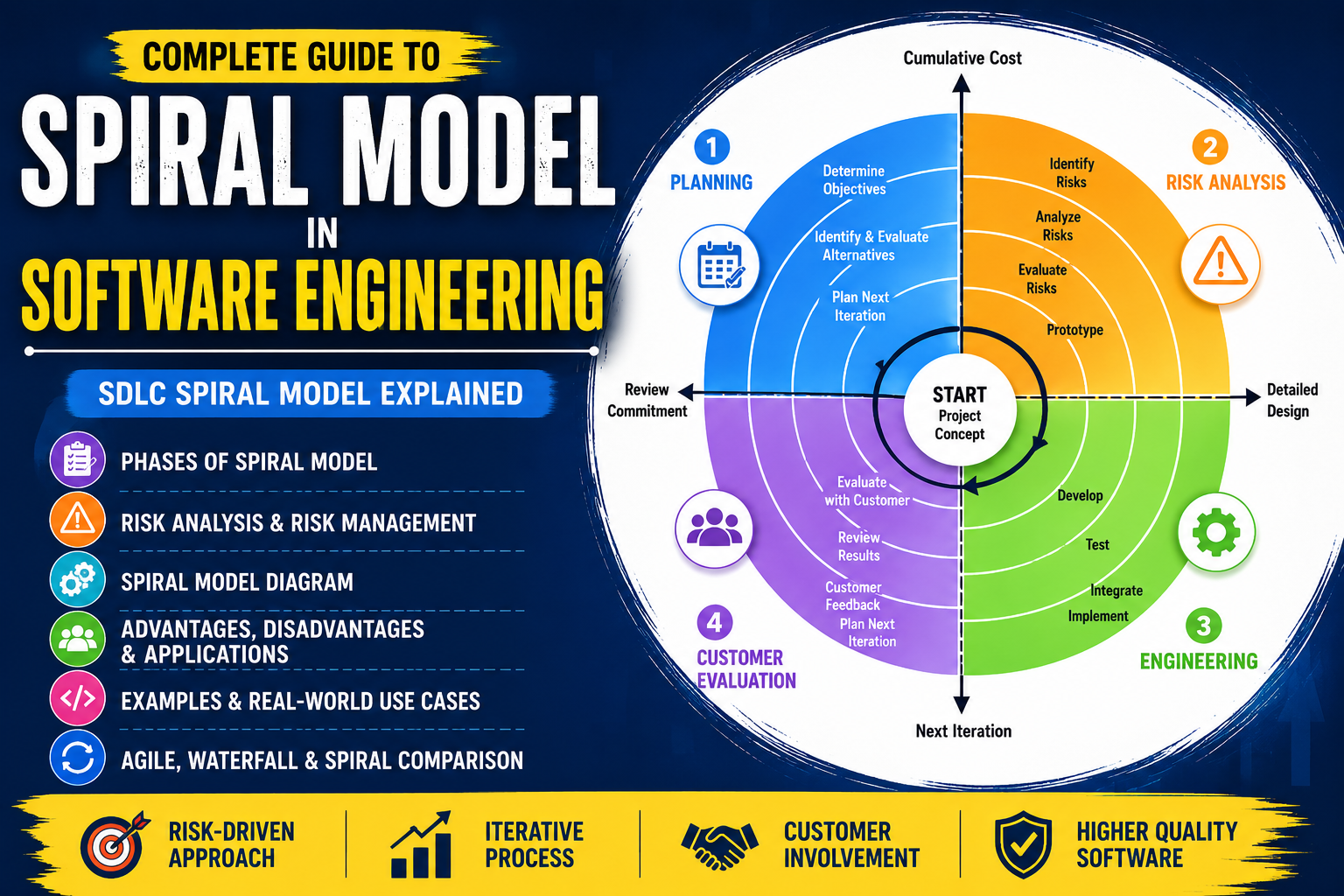
Spiral Model is one of the most reliable and risk-driven Software Development Life Cycle (SDLC) models used for developing large, complex, and high-risk software projects. Unlike traditional development approaches, the Spiral Model combines the advantages of iterative development, prototyping, and systematic risk management. This makes it an ideal choice for projects where requirements evolve over time and continuous customer feedback is essential.
The Software Engineering Spiral Model was introduced by Barry Boehm in 1986 to address the limitations of the Waterfall Model. Instead of following a fixed sequence of development phases, the Spiral Model allows developers to revisit each phase multiple times while continuously improving the software. Every loop of the spiral represents a new version of the software, making development flexible and highly adaptable.
Today, organizations developing enterprise software, banking systems, healthcare applications, aerospace systems, defense software, and even modern cloud applications use the Spiral Development Model because of its strong focus on identifying and mitigating risks before they become costly problems.
Every successful software project begins with choosing the right SDLC methodology, but it also requires professional website development and scalable architecture. If you're planning a custom web application, explore our Website Development Services to build secure and high-performance business solutions.
In this detailed guide, you'll learn everything about the Spiral Model, including its phases, lifecycle, diagram, working process, advantages, disadvantages, real-world applications, and why it remains one of the most effective software development methodologies.
Spiral Model in Software Engineering
The Software Engineering Spiral Model is a software development methodology that combines the structured nature of the Waterfall Model with the flexibility of iterative development and prototyping.
Unlike traditional SDLC models, development progresses through multiple cycles called spirals. Each spiral includes planning, risk analysis, development, testing, and evaluation. After completing one cycle, the software becomes more refined, and the next spiral begins with improved understanding and updated requirements.
The biggest strength of the Spiral Model is its emphasis on risk management. Before developers invest significant resources into coding, potential risks are identified, analyzed, and resolved.
Key Characteristics
- Iterative software development
- Continuous customer feedback
- Risk-driven approach
- Flexible requirement handling
- Early prototype development
- Suitable for large-scale projects
- Continuous testing and improvement
This combination makes the Spiral Model particularly useful for projects where requirements are expected to change during development.
Organizations using the Spiral Model often invest in modern web application development to ensure scalable, secure, and user-friendly software products.
Spiral Development Model
The Spiral Development Model is designed to build software through repeated development cycles. Instead of delivering the final product at once, developers release improved versions after each iteration.
Each cycle adds new features while improving the quality of previously developed modules. This incremental development process reduces project risks and helps stakeholders validate the software throughout development.
The model emphasizes:
- Customer collaboration
- Frequent evaluation
- Risk reduction
- Continuous improvement
- Incremental software releases
This development strategy significantly increases the chances of project success compared to rigid development models.
Businesses developing enterprise software frequently combine the Spiral Model with professional custom website development to create scalable digital solutions.
Spiral Life Cycle Model
The Spiral Life Cycle Model represents the complete lifecycle of software development through multiple spirals.
Each spiral includes four major activities:
- Planning
- Risk Analysis
- Engineering
- Evaluation
As the project moves outward in the spiral, the software becomes more complete and refined.
Unlike linear SDLC models, the Spiral Life Cycle Model allows teams to revisit previous phases whenever necessary. This flexibility helps organizations adapt to changing business requirements without restarting the entire project.
Barry Boehm Spiral Model
The Barry Boehm Spiral Model was proposed by renowned software engineer Barry W. Boehm in 1986.
His objective was to create a software development process that minimized project failures caused by:
- Unclear requirements
- Poor planning
- Technical uncertainties
- Budget overruns
- Schedule delays
Barry Boehm combined several existing software development concepts, including:
- Waterfall Model
- Prototyping Model
- Iterative Development
- Risk Management
The result was the Spiral Model, which quickly became one of the most respected software engineering methodologies for managing complex projects.
Today, the Boehm Spiral Model continues to be taught in universities and widely adopted by software organizations worldwide.
Boehm Spiral Model
The Boehm Spiral Model is often referred to simply as the Spiral Model because Barry Boehm introduced the methodology.
Its fundamental principle is simple:
Every software project contains risks, and successful software development depends on identifying and resolving those risks as early as possible.
Rather than assuming all project requirements are fixed, the Boehm Spiral Model accepts uncertainty and provides a structured process for handling changes efficiently.
This makes it particularly suitable for:
- Enterprise software
- Banking applications
- Healthcare systems
- Government software
- Defense projects
- Artificial Intelligence applications
- ERP systems
Spiral Model Diagram
A Spiral Model Diagram visually represents the iterative nature of software development.
The spiral expands outward with each completed cycle. Every loop consists of four quadrants representing the major development activities.
Typical Spiral Model Diagram Structure:
Customer Evaluation
▲
│
Engineering │
│
Planning ◄──────────► Risk Analysis
Each complete loop represents:
- A new software version
- Improved functionality
- Reduced project risk
- Better customer feedback
- Higher software quality
As the project progresses, the radius of the spiral increases, indicating greater investment, increased functionality, and reduced uncertainty.
Image Placement Suggestion: Insert a professionally designed Spiral Model Diagram here with labels for Planning, Risk Analysis, Engineering, and Customer Evaluation.
SDLC Spiral Model
The SDLC Spiral Model is one of the most advanced Software Development Life Cycle methodologies because it integrates planning, prototyping, development, testing, and risk analysis into every iteration.
Unlike the Waterfall Model, where testing occurs near the end of development, the Spiral Model incorporates testing into every development cycle.
The SDLC Spiral Model follows these principles:
- Continuous planning
- Continuous development
- Continuous testing
- Continuous customer involvement
- Continuous improvement
This iterative approach significantly reduces software defects and increases project success rates.
Software Development Life Cycle Spiral Model
The Software Development Life Cycle Spiral Model is widely used for mission-critical software projects where project risks must be carefully managed.
Instead of building the entire application at once, the development team delivers multiple working versions of the software.
Each version undergoes:
- Requirement validation
- Design review
- Development
- Testing
- Customer feedback
- Risk assessment
The next iteration begins only after reviewing lessons learned from the previous cycle.
This structured process ensures that software quality continuously improves throughout the project lifecycle.
Software Development Spiral Model
The Software Development Spiral Model combines several modern software engineering principles into one flexible methodology.
It supports:
- Incremental development
- Continuous integration
- Customer collaboration
- Prototype creation
- Risk-driven planning
- Progressive refinement
Organizations prefer this approach because it allows teams to adapt quickly to changing customer needs while maintaining high software quality.
Unlike rigid SDLC models, the Spiral Model accommodates evolving business requirements without disrupting the entire development process.
Spiral Method of Software Development
The Spiral Method of Software Development focuses on developing software in manageable iterations rather than completing all work in a single phase.
Each iteration includes:
- Requirement gathering
- Feasibility analysis
- Risk identification
- Design
- Coding
- Testing
- Customer review
By repeating these activities throughout the project, development teams can continuously improve the software while minimizing project risks.
The spiral method is especially valuable when project requirements are uncertain or expected to evolve over time, making it a preferred methodology for innovative and large-scale software solutions.
Spiral Process Model
The Spiral Process Model is a risk-oriented software development methodology that combines the strengths of the Waterfall Model, Prototyping Model, and Iterative Development. Instead of progressing through a single sequence of phases, the software evolves through multiple cycles, with each cycle producing a more refined version of the product.
Every iteration follows a structured approach where planning, risk assessment, engineering, and customer evaluation are repeated. This enables development teams to detect issues early, incorporate user feedback, and adapt to changing business requirements without disrupting the entire project.
Features of the Spiral Process Model
- Iterative software development
- Continuous customer participation
- Strong emphasis on risk management
- Prototype creation during development
- Flexible requirement handling
- Incremental software delivery
- High-quality testing in every iteration
This model is especially beneficial for projects involving emerging technologies or uncertain requirements.
Spiral Process Model in Software Engineering
The Spiral Process Model in Software Engineering is widely used for projects where technical complexity and business risks are high. Unlike traditional SDLC models, it does not assume that all requirements are fixed from the beginning.
Software engineers use this approach to gradually refine the product while continuously validating assumptions and minimizing technical risks.
Why Software Engineers Prefer the Spiral Process Model
- Requirements can evolve during development.
- Customer feedback is collected after every cycle.
- Risks are identified before major investments.
- Development costs become more predictable.
- The final software closely matches customer expectations.
Industries such as banking, healthcare, aerospace, defense, insurance, and enterprise software frequently adopt this methodology because of its reliability.
Spiral Development Process
The Spiral Development Process consists of repeated development cycles known as spirals. Every spiral includes four major quadrants that guide the software toward completion while reducing project uncertainty.
Phase 1: Planning
The planning phase begins with gathering project requirements, defining objectives, estimating costs, and identifying possible constraints.
Activities include:
- Requirement analysis
- Project planning
- Budget estimation
- Resource allocation
- Timeline creation
- Initial feasibility study
Proper planning ensures that every spiral starts with clear goals.
Phase 2: Risk Analysis in Spiral Model
Risk Analysis in Spiral Model is the most important phase because it distinguishes the Spiral Model from other SDLC methodologies.
During this phase, developers identify and analyze all potential risks that could affect the project.
Common Risks
- Technical risks
- Financial risks
- Security risks
- Schedule delays
- Requirement changes
- Integration issues
- Performance bottlenecks
Each identified risk is evaluated based on:
- Probability
- Business impact
- Technical complexity
- Cost implications
After evaluation, mitigation strategies are developed before actual coding begins.
This proactive approach significantly reduces project failure rates.
Risk Handling in Spiral Model
Risk Handling in Spiral Model involves creating strategies to eliminate or minimize identified risks before they become critical problems.
Typical risk handling techniques include:
- Building prototypes
- Conducting proof-of-concept development
- Using alternative technologies
- Revising software architecture
- Performing early testing
- Seeking stakeholder validation
For example, if a new payment gateway poses integration challenges, developers can create a small prototype to test compatibility before implementing it in the complete application.
This saves both time and development costs.
Risk Management in Spiral Model
Risk Management in Spiral Model is an ongoing activity that continues throughout every iteration of software development.
Rather than identifying risks only once, developers continuously monitor and reassess new risks after each spiral.
Risk Management Activities
- Risk identification
- Risk prioritization
- Risk mitigation planning
- Continuous monitoring
- Risk documentation
- Stakeholder communication
Benefits include:
- Lower project failure rates
- Better software quality
- Improved budget management
- Increased customer confidence
- Faster issue resolution
Organizations handling mission-critical software consider this one of the biggest advantages of the Spiral Model.
Engineering Phase of the Spiral Model
After planning and risk analysis, the project enters the engineering phase.
This is where developers convert approved requirements into working software.
Engineering activities include:
- System design
- Database design
- UI/UX development
- Backend development
- API integration
- Module coding
- Unit testing
- Integration testing
Unlike the Waterfall Model, the engineering work focuses only on the scope defined for the current iteration.
This incremental approach reduces complexity and allows frequent improvements.
Customer Evaluation Phase
Customer evaluation is the final quadrant of every spiral.
Here, stakeholders review the newly developed software version and provide valuable feedback.
Evaluation includes:
- Demonstration of new features
- Requirement validation
- Usability testing
- Business review
- Performance feedback
- Suggestions for improvement
Based on customer feedback, the next spiral begins with revised objectives.
Continuous customer involvement helps ensure the final product meets business expectations.
Spiral Cycle Model
The Spiral Cycle Model refers to the repeated loops of development that gradually enhance the software until completion.
Each cycle produces:
- Better software quality
- Reduced technical risk
- More complete functionality
- Improved documentation
- Enhanced user satisfaction
The number of cycles depends on:
- Project complexity
- Budget
- Customer requirements
- Risk level
- Development timeline
Large enterprise projects may require many iterations before deployment.
Spiral Prototype Model
The Spiral Prototype Model combines prototyping with iterative software development.
Before investing heavily in development, teams create prototypes to validate:
- User interface
- Business workflows
- Technical feasibility
- Customer expectations
Advantages include:
- Early customer feedback
- Reduced rework
- Better requirement understanding
- Lower project risks
This makes the Spiral Model particularly useful for innovative applications where users may not initially know exactly what they need.
Spiral Software Development Methodology
The Spiral Software Development Methodology provides a structured framework for building high-quality software through continuous refinement.
Its methodology emphasizes:
- Planning
- Prototyping
- Risk analysis
- Engineering
- Customer collaboration
- Continuous testing
Compared to linear development models, this methodology delivers greater flexibility and adaptability.
Organizations using Agile practices often incorporate Spiral principles into large enterprise projects to improve risk management.
Spiral Software Development Life Cycle
The Spiral Software Development Life Cycle represents the complete journey of software from concept to deployment through multiple iterative cycles.
Each iteration includes:
- Requirement gathering
- Risk assessment
- Design
- Development
- Testing
- Customer review
- Planning for the next iteration
This lifecycle ensures that software evolves gradually while maintaining high quality and reducing development risks.
Spiral Software Process Model
The Spiral Software Process Model is particularly effective when software projects involve uncertainty, frequent requirement changes, or high technical complexity.
Its process focuses on:
- Continuous improvement
- Customer satisfaction
- Risk minimization
- Incremental delivery
- Quality assurance
The software process remains flexible throughout development, allowing organizations to respond quickly to changing business needs.
Advantages of the Spiral Model
The Spiral Model offers numerous benefits, making it one of the most reliable SDLC methodologies.
1. Excellent Risk Management
Risks are identified and resolved before they affect the project.
2. High Software Quality
Continuous testing improves overall product quality.
3. Flexible Requirements
Requirement changes can be accommodated during development.
4. Customer Participation
Stakeholders review every iteration and provide valuable feedback.
5. Early Prototype Development
Customers can visualize the software before full implementation.
6. Better Cost Control
Early risk detection prevents expensive project failures.
7. Suitable for Large Projects
Complex enterprise applications benefit greatly from iterative development.
8. Continuous Improvement
Each iteration enhances software functionality and stability.
Disadvantages of the Spiral Model
Despite its strengths, the Spiral Model also has certain limitations.
High Development Cost
Continuous risk analysis increases project expenses.
Requires Risk Experts
Experienced project managers are needed to perform effective risk assessments.
Complex Project Management
Managing multiple iterations can be challenging.
Time-Consuming
Repeated planning and evaluation increase development time.
Unsuitable for Small Projects
Small applications may not justify the additional overhead of iterative risk management.
Example of Spiral Model
The Example of Spiral Model can be understood through the development of an Internet Banking System.
First Spiral
The development team gathers basic requirements such as:
- User Registration
- Secure Login
- Dashboard
- Account Summary
Before coding begins, developers analyze risks such as authentication security, database performance, and user privacy. A prototype is created, reviewed by stakeholders, and approved.
Second Spiral
The second iteration introduces:
- Fund Transfer
- Transaction History
- Beneficiary Management
New risks such as transaction failures, encryption, and server load are identified and addressed before development proceeds.
Third Spiral
The third cycle includes:
- Bill Payments
- Mobile Banking
- QR Payments
- Notifications
- Customer Support
Again, developers perform testing, collect customer feedback, and improve the software.
Fourth Spiral
The final spiral focuses on:
- Performance Optimization
- Security Audits
- Compliance Testing
- Bug Fixes
- Deployment Preparation
This example demonstrates how the Spiral Model gradually transforms a basic concept into a robust, secure, and feature-rich software product.
Spiral Model Applications
The Spiral Model Applications span industries where projects are complex, expensive, or involve evolving requirements.
Common applications include:
- Banking Software
- Healthcare Management Systems
- Insurance Platforms
- Government Projects
- ERP Solutions
- CRM Software
- Cloud Applications
- Artificial Intelligence Systems
- Machine Learning Platforms
- Enterprise Resource Planning
- Cybersecurity Solutions
- Aerospace Software
- Defense Systems
- Financial Management Software
The Spiral Model is most effective when project risks need continuous evaluation throughout the development lifecycle.
Spiral Model for Game Development
The Spiral Model for Game Development is widely used because modern games often undergo frequent design changes based on player feedback.
Each development cycle can include:
- Story Design
- Character Development
- Gameplay Mechanics
- Physics Engine
- Multiplayer Features
- Graphics Optimization
- Beta Testing
Game studios release playable builds after each iteration, gather feedback from testers, and refine gameplay in subsequent spirals. This iterative process improves user experience while minimizing costly redesigns late in development.
Spiral Model for Library Management System
The Spiral Model for Library Management System provides a practical example of iterative software development.
Iteration 1
- Student Registration
- Librarian Login
- Book Database
Iteration 2
- Book Issue
- Book Return
- Search Functionality
Iteration 3
- Fine Calculation
- Reservation System
- Notifications
Iteration 4
- Reports
- Analytics
- Barcode Integration
- Performance Optimization
Each iteration undergoes testing, user review, and risk analysis before moving to the next cycle.
Spiral Model in Embedded System
The Spiral Model in Embedded System development is useful because embedded applications often involve hardware and software integration.
Examples include:
- Medical Devices
- Automotive Control Systems
- Smart Home Devices
- Industrial Automation
- Robotics
- IoT Devices
The model allows developers to validate hardware compatibility, firmware behavior, and system performance during every development cycle.
Spiral Model in Software Testing
The Spiral Model in Software Testing integrates testing into every iteration instead of waiting until development is complete.
Testing activities include:
- Unit Testing
- Integration Testing
- System Testing
- Regression Testing
- Performance Testing
- Security Testing
- User Acceptance Testing (UAT)
Continuous testing reduces defects early, lowers maintenance costs, and improves software reliability.
Spiral Testing in Software Testing
Spiral Testing in Software Testing refers to performing validation and verification repeatedly throughout the software lifecycle.
Benefits include:
- Early bug detection
- Improved code quality
- Better performance
- Faster issue resolution
- Reduced project risk
- Higher customer satisfaction
This approach aligns well with modern quality assurance practices where testing is an ongoing activity.
Agile and Spiral Model
The Agile and Spiral Model share several similarities, including iterative development and continuous customer involvement. However, their primary focus differs.
| Feature | Agile | Spiral Model |
|---|---|---|
| Primary Focus | Rapid Delivery | Risk Management |
| Iterations | Short Sprints | Risk-Based Cycles |
| Customer Feedback | Continuous | Continuous |
| Risk Analysis | Limited | Extensive |
| Best For | Dynamic Projects | High-Risk Projects |
Many organizations combine Agile practices with Spiral principles to achieve both flexibility and strong risk control.
Agile Spiral Model
The Agile Spiral Model blends Agile methodologies with the structured risk management of the Spiral Model.
Benefits include:
- Faster software releases
- Continuous stakeholder collaboration
- Better adaptability
- Stronger risk mitigation
- Improved software quality
This hybrid approach is increasingly popular in enterprise software development.
Agile System Development and Spiral Models
The Agile System Development and Spiral Models complement each other in large-scale projects.
Agile contributes:
- Sprint Planning
- Daily Collaboration
- Continuous Integration
- Rapid Feedback
The Spiral Model contributes:
- Risk Assessment
- Prototype Validation
- Structured Planning
- Incremental Development
Together, they enable teams to manage complexity while maintaining flexibility.
Spiral Waterfall Model
The Spiral Waterfall Model combines the sequential structure of the Waterfall Model with the iterative, risk-driven nature of the Spiral Model.
Organizations sometimes adopt this approach when:
- Core requirements are stable.
- Certain modules require iterative refinement.
- High-risk components need additional validation.
- Regulatory compliance demands structured documentation.
This hybrid model balances predictability with adaptability.
Waterfall Spiral and Agile Methodologies
Waterfall Spiral and Agile Methodologies each have unique strengths.
| Waterfall | Spiral | Agile |
|---|---|---|
| Linear Process | Iterative | Iterative |
| Low Flexibility | High Flexibility | Very High Flexibility |
| Minimal Risk Analysis | Extensive Risk Analysis | Moderate Risk Analysis |
| Fixed Requirements | Evolving Requirements | Frequently Changing Requirements |
| Late Testing | Continuous Testing | Continuous Testing |
Selecting the right methodology depends on project size, complexity, budget, timeline, and risk profile.
Incremental Commitment Spiral Model
The Incremental Commitment Spiral Model is an advanced version of the Spiral Model that emphasizes gradual investment and stakeholder commitment.
Instead of committing the entire project budget upfront, organizations make informed decisions after each iteration based on:
- Risk Analysis
- Customer Feedback
- Cost Evaluation
- Technical Feasibility
- Business Value
This approach minimizes financial risk and supports better decision-making throughout the project lifecycle.
Conclusion
The Spiral Model remains one of the most effective software development methodologies for managing complex and high-risk projects. By combining iterative development, prototyping, continuous customer feedback, and comprehensive risk management, it enables organizations to deliver reliable and scalable software solutions.
Whether you are developing enterprise applications, banking systems, healthcare software, embedded systems, or modern cloud-based platforms, the Spiral Model provides the flexibility to adapt to changing requirements while maintaining high quality. Although it may require greater planning, expertise, and investment than simpler SDLC models, its emphasis on early risk identification and continuous improvement often results in higher project success rates.
Choosing the Spiral Model is particularly beneficial when project requirements are uncertain, technology is evolving, or the cost of failure is high. With its proven methodology and practical advantages, it continues to be a preferred choice for software engineers and project managers worldwide.
If you're planning to build a custom website, enterprise web application, SaaS platform, or business portal, choosing the right SDLC model is only the first step. At Webthropic, we specialize in professional website development, UI/UX design, and scalable web solutions that help businesses grow online. Explore our web development services to turn your ideas into high-performing digital products.
Frequently Asked Questions (FAQs)
1. What is the Spiral Model in software engineering?
The Spiral Model is a risk-driven SDLC methodology that combines iterative development, prototyping, planning, and continuous risk analysis to build software incrementally.
2. Who developed the Spiral Model?
The Spiral Model was introduced by Barry W. Boehm in 1986 to address the limitations of traditional software development models.
3. What are the four phases of the Spiral Model?
The four phases are:
- Planning
- Risk Analysis
- Engineering (Development)
- Customer Evaluation
4. Why is risk analysis important in the Spiral Model?
Risk analysis helps identify and resolve technical, financial, and operational risks before significant development resources are invested.
5. Which projects are best suited for the Spiral Model?
Large-scale, high-budget, and high-risk projects such as banking systems, healthcare software, defense applications, ERP systems, and enterprise platforms.
6. What is the main advantage of the Spiral Model?
Its strongest advantage is effective risk management combined with continuous customer feedback and iterative development.
7. How is the Spiral Model different from the Waterfall Model?
Unlike the Waterfall Model's linear process, the Spiral Model repeats development cycles, allowing requirement changes and continuous improvement.
8. Can the Spiral Model be combined with Agile?
Yes. Many organizations use hybrid Agile-Spiral approaches to combine rapid delivery with structured risk management.
9. Is the Spiral Model suitable for small projects?
Generally, no. The overhead of repeated planning and risk analysis makes it less cost-effective for small or low-risk projects.
10. Why is the Spiral Model still relevant today?
Its focus on flexibility, stakeholder involvement, iterative delivery, and proactive risk management makes it highly suitable for modern software development.